accounts of race meets at the Kingston Race Course
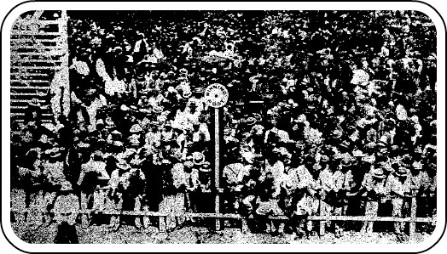
view of part of the crowd on the Kingston Race Course when racing there was revived in 1930
There were problems just getting to the Race Course:
The streets and roads leading to the Race Course from all directions presented a very animated scene yesterday afternoon. Along Duke Street and East Street poured a continuous stream of busses, buggies and waggonettes, each carrying a heavy load of sightseers. Duke Street was almost hidden by the clouds of dust raised by the vehicles, and one had to breathe an atmosphere that was a great deal thicker than it was wholesome, and that contained almost everything but ozone. Kingston streets are not the pleasantest to travel at the best of times, but yesterday a drive along our principal thoroughfares was a most distressing experience. We venture to suggest that if a water-cart were to be sent along Harbour Street, Duke Street and several other principal streets to-day, and some effort made to lay the dust, the pleasure of our visitors and, incidentally, of our citizens, would be greatly enhanced.
Daily Gleaner, December 12, 1889
H G DeLisser writing in 1909:
Daily Gleaner, November 20, 1909
At the Races
STRANGE, HUMOUROUS SCENES
Descriptions of the Manners
Of Some “Sports.”
(By H. G. DeLisser, Literary Editor of the Gleaner).
Cricket and tennis played under a flaming sky mean strenuous exercise, yet they are “sport” and so are popular in Jamaica. Horse-racing, garden parties, dancing: those are popular pastimes too; and I think the most popular of them is dancing, with racing a close second.
It is at a Jamaica meet that you see the Jamaica women at their best. The Grand Stand is crowded and every woman wears a new frock (the best she can afford) and consciously tries to look her handsomest; the meet is a parade of fashion and of frocks, of bodies, of eyes, of hats, of everything that a woman has and thinks about; it is a show of women; the best that Jamaica can put forth.
I think a race course is a place where you see much that is typically Jamaican. Let me describe a meet as I have seen it on the old Kingston Course, when thousands of people were present, from the Governor to the truant from school. The Grand Stand was to the west, and this was filled to overflowing with women and men. Walking amongst them you perceived two things: first, that the island of Jamaica is one of those spots of the globe where all or nearly all the different races of the British Empire are represented: next that class and colour are meaningless terms at a great public function such as this. Black men and women of comfortable position sat side by side with tourists from England: Hindoos elbowed officers of His Majesty’s army: Chinese from Hong Kong, dressed in European costume, sat silently looking down upon the course beside enthusiastic Jamaica girls whose deep brunette complexion and rapid gestures betokened the mixture of white and black blood in their veins, The price of admission was the same for every one: four shillings. So clerks and shopmen, well-to-do artisans, prosperous merchants, professional men (clergymen excepted), Government officials, Chinese retailers, planters and others, all had come with their wives, daughters and sweethearts, and all were in the Stand: for not to be in the Stand was an open and visible confession of poverty; it was in truth to write yourself down a plebeian and be counted amongst the people of the course.
The Stand was crowded, the paddock below it was crowded. The sun shone fiercely, lighting up an animated people. What colours the dresses were: pinks and blues, white, silver-grey, maroon, purple - l cannot run through the catalogue. And the men? Well, at a race meeting in Jamaica a striking costume for men is considered to be “the proper thing,” so we wear flannels and red neckties, and rakish hats, and all the other paraphernalia of “sportsmen,” and we all discuss the merits of the horses with the assumption of deep knowledge and a keen understanding of equine characteristics. Friends nod cheerfully to one another, and even acquaintances speak with but a moderate show of restraint, for racing is supposed to relax class distinctions during the time that it lasts. There is a buz and murmur of conversation. Very small boys go about making very large bets, and everyone is hot and perspiring, and pretends to be desperately happy. Or, perhaps, does not pretend. Perhaps everybody is happy: happy in a respectable sort of way. Down below on the open sward, however, where the green grass and the yellow flowers are beneath one’s feet, and the blue sky and the sun are above – there where all restraint is thrown to the four winds of Heaven, is one of the merriest and noisiest crowds in the world.
The course is studded with numerous booths, and everywhere you turn your eyes you will see a tiny column of smoke curling up towards the sky. Fire places of a few loose bricks have been built all about, and on these hundreds of pots are boiling and scores of frying-pans hissing and spluttering. Benches are near, and boxes filled with plates and knives and spoons; and sitting on these benches or squatted on the green sward are laughing girls, black and brown; while perhaps stretched out at full length upon the ground are their admirers – stalwart young men who have come to enjoy themselves at the races and who take a special delight in describing themselves as “bad men.”
A “bad man” in Jamaica means one who will stop short at nothing in the way of ruffianism. As a matter of fact the most of these young men are entirely harmless. But at the races you are supposed to be ready to proceed to any extremes; consequently every man and boy upon the course is armed with a huge stick which he flourishes at intervals by way of establishing his claim to be considered bad. The girls, their voices raised to a scream at moments of excitement, talk of the races and bet in three-penny pieces upon their favourite horses. Meanwhile they eat; for in the pots and pans all about are viands beloved of the Jamaican working classes. Rice boiled with red peas and flavoured with cocoanut oil and fried salt pork; boiled salted fish seasoned with lard or cotton seed oil, and served with yam and cocoa and large flour dumplings; stewed beef with rice and yam. A portion of any of their dishes you may have for 3d. or 6d. according to the quantity of the food and the status of the temporary restaurant.
The course is studded with vendors of all sorts. The “pindar boy” with his basket of parched nuts, the ice-cream seller pushing about his [?] cart, women with tubs filled with bottles of “cool drink”, women with trays of iced sponge cakes (known as “race cakes”), big carts filled with cocoanuts at a penny each – all Kingston’s population of itinerant vendors is here to-day, and the young men and the women buy from them, and the little boys follow their movements with wistful, longing eyes.
Little structures rise here and there upon the course. They are bars and they are always filled. Temperate as the Jamaican is by habit and nature, many a man feels that he will not do justice to himself and to his friends to-day unless he becomes mildly intoxicated and offers to fight you on the slightest suspicion of disagreement on your part with any opinion he may care to express. Betting proceeds gaily; and now and then a wild scattering of the crowd proclaims that a combat is taking place. This is known as a “stick licking,” for it usually begins with the irate gentleman of villainous aspect leaping two feet into the air, calling upon the Almighty to strike him dead first and blind afterwards, then coming down with his stick - on his opponent’s head? That was his intention. But the other man has a stick also, and he deftly fences off the blow; after which stick encounters stick in a series of rapid flourishes, the men and women friends of each of the combatants grow frenzied with excitement, the women shriek “murder!” and implore the men to “Hold Johnny!” “Tek ‘way Richard!”



